




Setting Up AI Voice Agents for Automated Lead Qualification
 Eldad Gaih6 May 202610 Mins read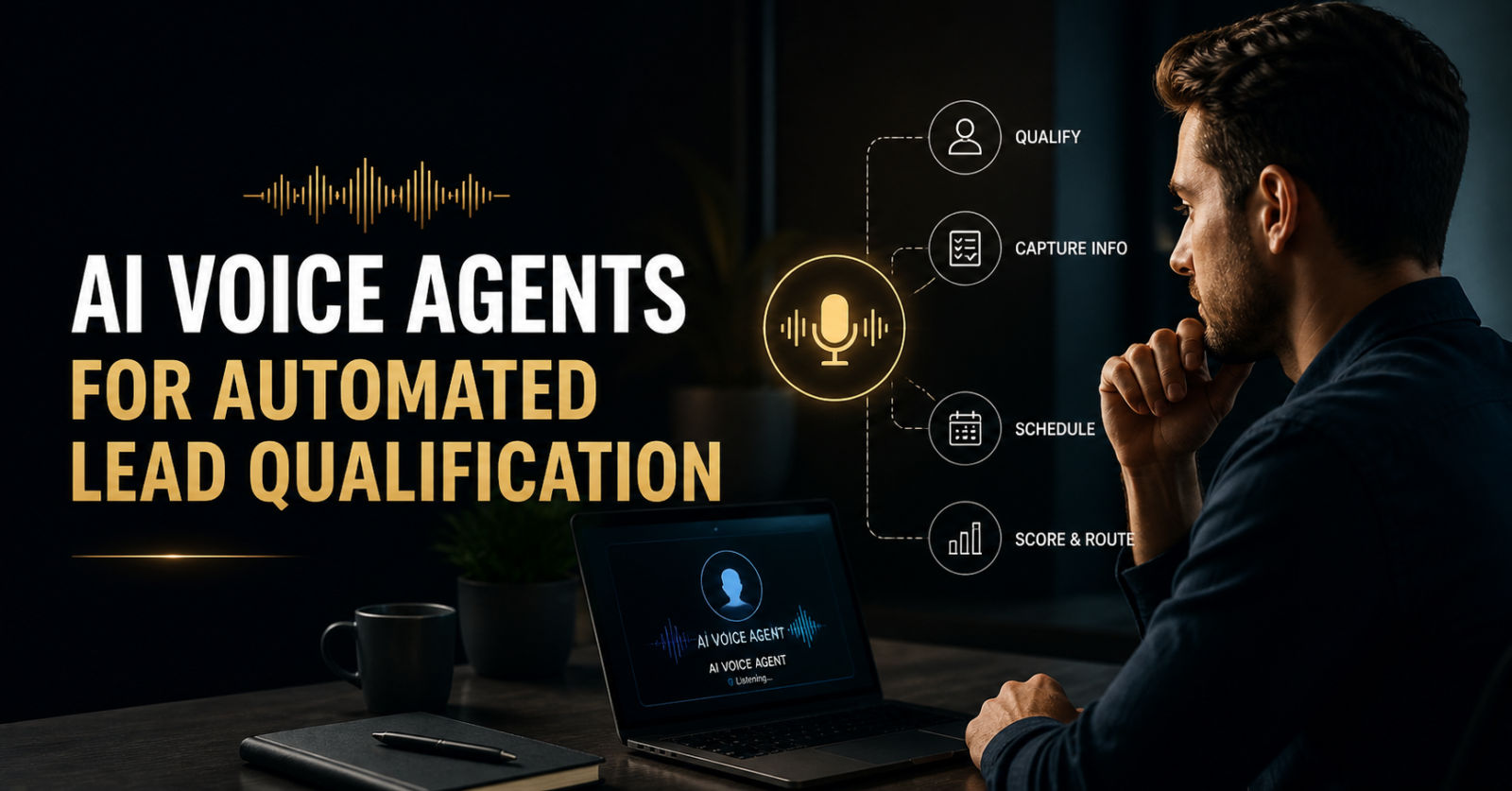
How to implement 24/7 AI phone agents that qualify prospects, handle objections, and schedule meetings — without adding headcount.
Every inbound lead that doesn’t get a callback within five minutes is 21 times less likely to convert than one that does, according to research from Harvard Business Review. Most sales teams can’t respond that fast. Their reps are in meetings, handling other calls, or simply offline when a prospect fills in a form at 9pm.
AI voice agents solve this problem directly. They answer calls instantly, carry on natural-sounding conversations, qualify leads against your criteria, handle common objections, and book meetings — around the clock, without a human involved.
Research cited by CloudTalk shows that calls between 4–5pm convert 71% better than morning calls, and that 73% of companies plan to adopt voice AI by the end of 2025. The businesses that move first get those leads. The ones that wait hand them to competitors who already have AI answering.
This guide walks through how AI voice agents work, which platforms to use, how to implement them, and what to realistically expect.
Our top pick for most businesses is CloudTalk — for its CeTe AI voice agents that handle 60+ languages, integrate with CRMs out of the box, and deliver natural-sounding conversations at scale.
Quick Comparison: Best AI Voice Agent Platforms of 2026
| Platform | Best For | Starting Price | Free Trial | Languages |
|---|---|---|---|---|
| CloudTalk | Multi-language AI voice + CRM | From $25/user/mo | ✅ 14 days | 60+ |
| Aircall | Teams wanting native AI voice agent | From $30/license/mo | ✅ 7 days | Multiple |
| CallHippo | Affordable VoIP + AI live coaching | Custom | ✅ | Multiple |
| Calilio | Budget-conscious small businesses | From $15/user/mo | ✅ | Multiple |
| Demodesk | AI-assisted call coaching for sales teams | Custom | ✅ | Multiple |
What AI Voice Agents Actually Do (And What They Don’t)
An AI voice agent is a software system that conducts real phone conversations using natural language processing, voice synthesis, and decision logic. Modern agents go far beyond the robotic IVR menus of the past — they listen, interpret context, respond naturally, and adapt based on what a prospect says.
What they handle well:
- Answering inbound calls 24/7 with zero wait time
- Asking qualification questions (budget, timeline, decision-making authority)
- Handling standard objections and FAQs
- Scheduling follow-up calls or demos directly into a rep’s calendar
- Gathering lead data and syncing it to your CRM automatically
- Making outbound calls to inbound form submissions within seconds
What still needs a human:
- Complex, multi-stakeholder discovery conversations
- Late-stage objection handling with senior enterprise buyers
- Relationship-sensitive accounts where a human touch matters
- Conversations requiring deep product knowledge and custom problem-solving
The most effective implementations divide the workload clearly: AI handles initial contact, qualification, and scheduling. Humans handle the conversations that actually close deals.
The 5 Best AI Voice Agent Platforms Reviewed
Best Overall: Multi-Language AI with CRM Integration
CloudTalk
Enterprise-grade AI voice with global reach and deep CRM connectivity
Reasons to buy:
- CeTe AI voice agents conduct natural conversations in 60+ languages
- Covers 160+ countries with number reputation management to avoid spam labels
- Handles concurrent calls — no queue, no wait
- Live CRM data personalizes every conversation in real time
- Built-in number reputation management prevents spam labels
Reasons to avoid:
- Key features like power dialers and Salesforce integration require higher-tier plans
- AI conversation intelligence is a paid add-on, not included in base plans
- Some users report occasional call quality issues
Features:
- CeTe AI voice agents for inbound and outbound
- 60+ language support with natural language understanding
- Real-time CRM personalization during calls
- Intelligent routing and follow-up automation
- Advanced analytics with call recording and transcription
At a glance
CloudTalk’s CeTe AI agents are what separates it from basic VoIP platforms. CeTe doesn’t just read a script — it listens to prospect responses, interprets context, adjusts its conversation path accordingly, and pulls live CRM data mid-call to personalize responses. When a returning customer calls in, CeTe knows their history before saying hello.
For businesses serving international markets, the 60+ language capability is genuinely differentiating. Most competitors support a handful of languages. CloudTalk covers the major commercial markets and many emerging ones, making it viable for global outbound campaigns and multinational businesses without needing a human agent for each language region.
The platform excels at high-volume environments — handling 50 to 5,000 calls per day on the same infrastructure, with Expert and Custom plans designed to adapt during peak periods without degradation.
Pricing
| Plan | Monthly Price | Annual Price | Key Features |
|---|---|---|---|
| Starter | $34/user | $25/user | Basic calling, recording, ACD |
| Essential | ~$34/user | $29/user | + Integrations, analytics |
| Expert | ~$69/user | $49/user | + Salesforce, smart dialer, AI add-on |
| Custom | Quote | Quote | Enterprise features |
Note: AI conversation intelligence is a paid add-on on Essential and Expert plans.
Verdict
CloudTalk is the strongest all-around platform for businesses running global or multi-language sales operations and wanting AI voice agents integrated directly into their phone infrastructure. Best for teams of 5+ that also need a full-featured VoIP system alongside the AI layer.
Start a CloudTalk free trial →
Best for Native AI Voice with Simple Setup
Aircall
Clean, well-integrated AI voice agent for growing sales teams
Reasons to buy:
- AI Voice Agent handles inbound calls autonomously with natural conversation quality
- 7,000+ integrations including Salesforce, HubSpot, Slack, and Zendesk
- Shared call inboxes and real-time monitoring for team coordination
- 15,000+ businesses trust the platform, giving strong market validation
Reasons to avoid:
- Minimum 3-license requirement means minimum $90/month even for solo users
- Advanced analytics locked behind higher plans
- Some users report call quality issues and slow customer support response
Features:
- Aircall AI Voice Agent for autonomous inbound call handling
- Real-time call monitoring with listen, whisper, and barge capabilities
- Call tagging and shared inboxes
- Power Dialer on Professional plan
- Voicemail Drop
- 7,000+ integrations
At a glance
Aircall’s AI Voice Agent is designed to sound human enough that callers don’t immediately disengage. The platform positions itself around ease of deployment — teams report being up and running within hours rather than days, a meaningful advantage over more complex contact center platforms.
The real strength is the integration ecosystem. With 7,000+ native integrations, Aircall slots into almost any existing tech stack without custom development. When a lead calls in and gets qualified by the AI agent, that qualification data flows automatically into your CRM, your email sequence tool, and your scheduling platform.
Aircall’s per-license pricing (not per-user) is a nuance worth understanding: you pay for phone lines, not people. The minimum three-license requirement means the real starting cost is $90/month even if you have one rep — factor this into your evaluation.
Pricing
| Plan | Annual Price | Monthly Price |
|---|---|---|
| Essentials | $30/license/mo | $40/license/mo |
| Professional | $50/license/mo | $70/license/mo |
| Custom | Quote | Quote |
Minimum 3 licenses required. Custom plan requires minimum 25 licenses.
Verdict
Aircall is the right choice for sales teams that want a native AI voice agent inside a mature, well-integrated phone system. The 7-day trial is worth taking to test call quality and AI conversation naturalness before committing to a 3-license minimum.
Best for Budget-Conscious Teams + AI Coaching
CallHippo
Affordable virtual phone system with real-time AI coaching for agents
Reasons to buy:
- AI Live Coach gives reps real-time suggestions during calls — improving conversion on the spot
- Full call monitoring suite: listen, whisper, and barge
- Strong mobile app for remote and field sales teams
- Global virtual number support
Reasons to avoid:
- AI analytics and full features locked behind higher plans
- Occasional call connectivity issues reported by users
- Less robust AI voice agent compared to CloudTalk or Aircall
Features:
- AI Live Coach for real-time rep guidance during calls
- Call monitoring (silent listen, whisper coaching, barge)
- Global virtual number support
- Call recording and AI-driven analytics
- CRM integrations on higher plans
At a glance
CallHippo sits in a different part of the market from CloudTalk and Aircall. Rather than focusing on fully autonomous AI voice agents, it concentrates on AI that makes human agents better in real time. The AI Live Coach listens to every call and surfaces contextual suggestions — how to handle a specific objection, when to introduce pricing, which competitor differentiator to emphasize.
For sales teams that aren’t ready to hand conversations to AI entirely, CallHippo’s hybrid model is a compelling middle ground: AI-assisted humans who respond faster and more consistently than unassisted reps, without the quality risks of full automation.
Data from CallHippo also shows that calls made in the 4–5pm window convert 71% better — and their AI scheduling tools optimize outbound call timing automatically based on this kind of engagement data.
Pricing
CallHippo offers custom pricing based on team size and required features. Contact their sales team for a quote. Free trial available.
Verdict
CallHippo is best for teams that want AI to assist their reps rather than replace them, with a strong focus on coaching and compliance monitoring. Particularly valuable for businesses with remote sales teams that need consistent performance across distributed reps.
Best for Small Businesses on a Budget
Calilio
Affordable AI-powered calling with built-in call intelligence at the lowest entry price
Reasons to buy:
- Starting at $15/user/month — among the most affordable options in this category
- AI-generated call reports include transcription, sentiment, and outcome summaries
- AI reports available without expensive add-ons — included in base plans
- Transparent pricing with no hidden charges
Reasons to avoid:
- Fewer advanced features compared to CloudTalk or Aircall
- Smaller company with less market validation
- Less suitable for high-volume enterprise call centers
Features:
- AI-powered call reports with transcription and sentiment analysis
- Live call monitoring for supervisors
- Automated summaries of call outcomes
- Standard VoIP features: IVR, call recording, call forwarding
- CRM integration
At a glance
Calilio makes an explicit value argument: why pay $30–50/user/month for AI features locked behind add-ons when you can get AI-powered call reports, sentiment analysis, and transcription built into a $15/user plan? For small businesses that need insight into their calls without the budget for enterprise infrastructure, that argument holds up.
The AI reports are the headline feature. After every call, Calilio generates a summary that includes a transcript, a short summary of what was discussed, customer sentiment analysis, and the outcome of the conversation. Managers can review 20 calls in the time it would take to listen to two recordings — dramatically compressing the coaching and QA cycle.
Pricing
| Plan | Price |
|---|---|
| Basic | $15/user/mo (annual) |
| Pro | From $25/user/mo |
Verdict
Calilio is the best entry point for small businesses that want AI-enhanced calling without the budget or complexity of enterprise platforms. The built-in AI reports deliver genuine coaching value that larger platforms charge extra for. Best for teams of 2–15 reps who primarily need call insights and basic VoIP features.
Best for AI Sales Coaching and Meeting Intelligence
Demodesk
AI that transforms how your sales team handles calls, not just how it makes them
Reasons to buy:
- Real-time AI coaching during live calls with talk track suggestions
- Post-call AI generates summaries, follow-ups, and CRM updates automatically
- Coaching analytics identify where deals stall and which rep behaviors drive wins
- Strong integration with CRM and calendar tools
Reasons to avoid:
- Not a prospecting or call-volume tool — needs a VoIP platform alongside it
- Custom pricing without transparent starting rates
- Higher value for teams doing 10+ calls per week per rep
Features:
- Real-time AI meeting assistant
- Automated post-call summaries and follow-up drafts
- CRM auto-population after every meeting
- Coaching performance dashboards by rep and deal stage
- Calendar integration for frictionless booking
At a glance
Demodesk occupies a distinct category from the other platforms here. Rather than focusing on initial call handling or lead qualification, it focuses on optimizing what happens during strategic sales conversations — demos, discovery calls, negotiations, and relationship meetings where the outcome actually determines whether a deal closes.
The post-call automation alone changes the math for many teams. A rep doing 8 calls per day who spends 30 minutes on post-call admin saves 4 hours every day when Demodesk handles summaries, follow-up drafts, and CRM updates automatically. Across a five-rep team, that’s 100 hours a week returned to selling.
Pricing
Custom pricing based on team size. Contact Demodesk for a quote.
Verdict
Demodesk is the conversation intelligence layer that makes the rest of your sales stack more effective. Pair it with CloudTalk or Aircall for inbound qualification and you have a complete AI-powered phone operation — from first contact through meeting close.
How to Implement an AI Voice Agent: Step-by-Step
Step 1: Define Your Qualification Criteria
Before configuring any voice agent, write down exactly what makes a lead qualified. Common BANT criteria:
- Budget: Does the prospect have budget allocated for this type of purchase?
- Authority: Are they a decision maker, influencer, or end user?
- Need: Do they have the specific problem your product solves?
- Timeline: Are they evaluating within 30/60/90 days?
Your AI agent will ask these questions in natural conversation. The clearer your criteria, the more accurately it routes leads.
Step 2: Map Your Call Flows
Sketch out the main paths a call can take:
- Qualified lead → book meeting directly
- Interested but not decision maker → capture contact, schedule follow-up
- Wrong fit → politely end call, offer relevant resource
- Common objection (pricing, timing, competitor) → scripted AI response
Most platforms (CloudTalk, Aircall, CallHippo) include visual call flow builders that map these paths without coding.
Step 3: Write and Test Your Opening Script
The first 10 seconds of an AI call determine whether a prospect stays on the line. The best openings are:
- Specific to why the call is happening (e.g., “You filled in our form about [topic]”)
- Direct about the call being AI-assisted if required by your jurisdiction
- Value-first before asking questions
Research from Leaping AI shows that AI agents using immediate callbacks on inbound form completions — within 60 seconds — dramatically outperform those that call hours later. Speed to first contact is the most important variable.
Step 4: Integrate with Your CRM and Calendar
Every qualified call should automatically:
- Create or update a CRM contact record
- Log the call transcript and qualification notes
- Trigger the appropriate follow-up sequence
- Book the rep’s calendar if a meeting is requested
All five platforms in this guide support this workflow. CloudTalk and Aircall have the most extensive native integration libraries.
Step 5: Start With One Use Case, Then Expand
Don’t try to automate every call type on day one. Start with one high-value, well-defined use case:
- Inbound form completions → AI qualifies and books demo
- Event/webinar registrants → AI follows up with relevant information
- Outbound to stale leads → AI re-engages and identifies current interest
Measure results over 30 days, refine based on call recordings, then expand to additional use cases.
What to Expect: Realistic Benchmarks
Based on industry data from CloudTalk and Leaping AI:
| Metric | Without AI Voice Agent | With AI Voice Agent |
|---|---|---|
| Speed to first contact | 30 min–24 hours | Under 60 seconds |
| Contact rate (outbound) | 10–15% | 30–40% |
| Hours spent on call admin | 2–4 hrs/rep/day | 30 min/rep/day |
| Calls handled per rep | 30–50/day | 200–500/day (AI handles volume) |
| Lead qualification rate | Depends on rep | Consistent, measurable |
Frequently Asked Questions
Are AI voice agents detectable by prospects?
Modern AI voice synthesis (especially from platforms like CloudTalk and Aircall) is increasingly difficult to distinguish from human speech. However, in some jurisdictions — including several US states — you’re legally required to disclose that a call is AI-generated. Always check local requirements before deploying an outbound AI calling campaign.
Will AI voice agents damage my brand?
Only if implemented carelessly. A poorly scripted, robotic-sounding agent creates a worse impression than no agent at all. The platforms that work best invest in call quality, natural language variation, and escalation paths to humans when conversations get complex. Test extensively before going live.
Do I need a VoIP number to use these platforms?
Yes. All platforms in this guide are cloud-based and require you to set up virtual phone numbers. Most provide numbers in multiple countries, with local number options for better answer rates. Number reputation management (CloudTalk’s specialty) prevents your numbers from being flagged as spam.
Can AI voice agents make outbound calls as well as receive them?
Yes. The most effective use case for many businesses is outbound — calling inbound form completions within 60 seconds of submission, re-engaging cold leads, or conducting automated follow-up after a marketing event. CloudTalk, Aircall, and CallHippo all support outbound AI calling.
How much does a full AI voice agent implementation cost?
For a small business: $15–50/user/month for the platform, plus setup time. For a mid-market team with CRM integration and custom call flows: $50–100/user/month. Most platforms offer free trials — start there to validate fit before committing.
Disclosure: Some links in this article are affiliate links. We may earn a commission at no extra cost to you if you purchase through them.




Related Articles

Best AI-Powered Call Analytics: Understanding Every Conversation
How to implement AI call analysis that turns phone conversations into actionable...
Setting Up AI Receptionists That Handle Customer Calls 24/7
How to replace your front desk — or cover the hours no...
Best AI Phone Systems for Small Business: Complete Implementation Guide
How to choose, set up, and get ROI from an AI-powered phone...


Cold Email Automation With AI: Setting Up Campaigns That Actually Convert
A practical guide to building AI-powered cold email campaigns that reach the...

Leave a comment