




Best AI Content Personalization Platforms: Delivering Individualized Experiences at Scale (2026)
 Glen14 May 202612 Mins read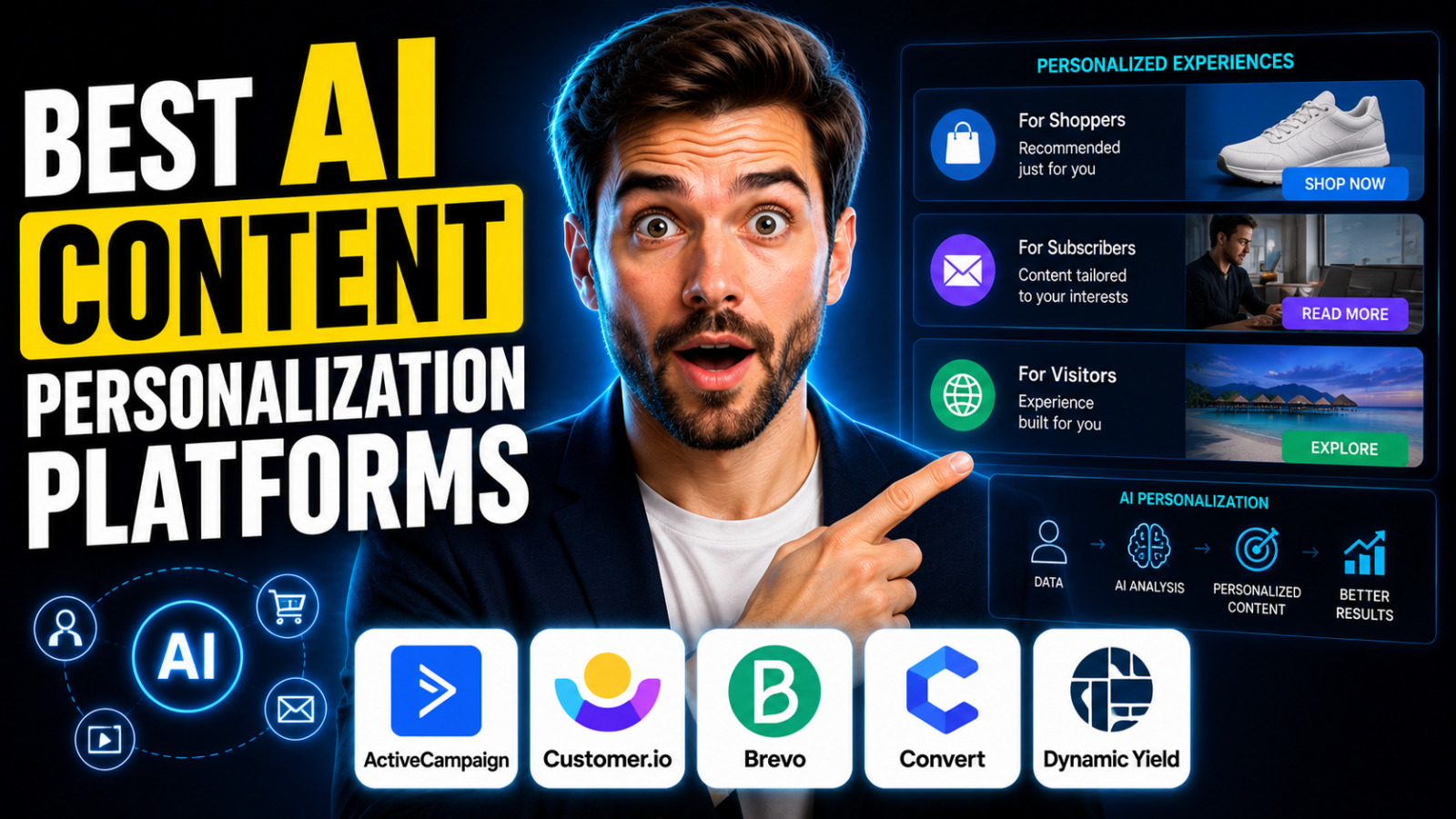
How to implement AI-powered personalization that adapts your messaging, offers, and recommendations to every visitor and which platforms make it actually achievable.
The average website shows the same homepage to a first-time visitor from Google and a returning customer who has purchased three times. The same email goes to someone who downloaded a pricing guide yesterday and someone who signed up for a newsletter eight months ago and hasn’t opened since. The same ad headline runs against audiences with completely different pain points.
This is the personalization gap and in 2026, it’s costing businesses real revenue.
McKinsey research shows that personalization can deliver 5–8x ROI on marketing spend and lift sales by 10% or more. The companies demonstrating fastest growth in e-commerce, SaaS, and professional services are the ones that have closed this gap with AI-powered personalization engines that adapt every touchpoint to the individual.
The catch is that real personalization at scale used to require a data science team and six-figure platform contracts. That’s no longer true. The platforms in this guide bring meaningful AI personalization to businesses of all sizes from growing e-commerce stores to mid-market SaaS companies without requiring technical expertise or enterprise budgets.
Our top pick for most businesses is ActiveCampaign for its combination of behavioral tracking, predictive content, AI Personalization Agent, and CRM-connected scoring that enables genuine 1:1 personalization across email, SMS, and web.
Need AI personalization built and managed for your business? Vitna Media Ltd implements full-stack AI personalization systems — from platform setup through content strategy and ongoing optimization.
Quick Comparison: Best AI Personalization Platforms (2026)
| Platform | Best For | Starting Price | Free Plan | Personalization Type |
|---|---|---|---|---|
| ActiveCampaign | Email + CRM personalization for growing businesses | $15/mo | ❌ (14-day trial) | Behavioral, predictive, AI-generated |
| Customer.io | Real-time event-based personalization for SaaS | From $100/mo | ❌ (30-day trial) | Event-triggered, API-driven |
| Brevo | Multi-channel personalization on a budget | Free / $9/mo | ✅ | Behavioral, send-time, dynamic content |
| Convert | Website A/B testing and personalization | From $199/mo | ❌ (15-day trial) | On-site, segmented, rule-based |
| Dynamic Yield | Enterprise-grade cross-channel personalization | Custom (enterprise) | ❌ | AI-driven, cross-channel, predictive |
What AI Personalization Actually Means
The word “personalization” is one of marketing’s most abused terms. Here’s what the spectrum actually looks like:
Level 1 — Basic (not AI): Inserting a contact’s first name into an email subject line. Using {{First Name}} in a greeting. This is mail merge, not personalization.
Level 2 — Segmentation: Sending different emails to different audience groups (new subscribers vs. customers vs. churned users). Better, but still batch-and-blast within segments.
Level 3 — Behavioral personalization: Triggering specific messages based on individual actions — a contact visits a pricing page, then receives a case study email; a customer buys product A, then receives product B recommendations. This is the minimum that qualifies as meaningful personalization.
Level 4 — Predictive personalization: AI predicts what a specific individual is most likely to want next, and serves content accordingly — without waiting for the individual to take a triggering action. This requires behavioral history and a trained model.
Level 5 — Real-time adaptive personalization: Every touchpoint (website, email, app, ad) adapts dynamically to what the AI knows about that individual at that precise moment. This is what Dynamic Yield and the enterprise-grade platforms deliver.
Most growing businesses should start at Level 3 and build toward Level 4. Level 5 is genuinely enterprise territory — valuable, but requiring significant data infrastructure.
The 5 Best AI Personalization Platforms Reviewed
Best Overall: Behavioral + Predictive Personalization
ActiveCampaign
The deepest behavioral personalization in the mid-market — now with autonomous AI Personalization Agent
Reasons to buy:
- AI Personalization Agent autonomously tailors content for each subscriber based on behavior and preferences
- Predictive content blocks show different email sections to different contacts based on historical engagement
- Site tracking and event tracking capture every behavior that informs personalization logic
- 900+ automation triggers enable granular behavioral responses without technical setup
Reasons to avoid:
- Personalization depth requires Plus plan ($49/mo) minimum — Starter plan automation limits make real personalization difficult
- Scaling contact costs make it expensive for very large lists (100K+ contacts)
- Learning curve for advanced conditional content and segmentation rules
Features:
- AI Personalization Agent: autonomously adapts content per subscriber
- Predictive Sending: per-contact optimal delivery timing
- Dynamic content blocks: different content for different segments within the same email
- Site tracking and event tracking: captures page views, form submissions, product interactions
- Lead scoring: AI-updated scores based on engagement behavior
- Conditional automations: branching logic based on any combination of behavioral signals
- Win Probability: AI estimates deal close likelihood in CRM
At a glance
ActiveCampaign’s personalization architecture is built on a simple but powerful principle: every action a contact takes — on your website, in your emails, in your product — should inform what they receive next. Site tracking logs every page view. Event tracking logs every form submission, purchase, and custom action. These signals feed into lead scores, automation triggers, and predictive content logic simultaneously.
The AI Personalization Agent, launched as part of ActiveCampaign’s 25+ AI agents in 2025, takes this further. Rather than requiring marketers to manually configure which content should appear for which segment, the Agent analyzes each subscriber’s full behavioral history and autonomously selects the most relevant content variant for every send. ActiveCampaign’s case study of a platform managing 100,000+ artists showed 70%+ open rates on re-engagement automations built on behavioral personalization — performance that generic segmentation can’t replicate.
Predictive content is where the AI personalization becomes most visible to the subscriber. Within a single email template, different contacts see different value propositions, different product recommendations, or different CTAs — all determined by the AI based on what their engagement history indicates they’re most likely to respond to. The email looks handcrafted; the system makes it effortless.
Pricing
| Plan | Price (1K contacts, annual) | Personalization Features |
|---|---|---|
| Starter | $15/mo | Basic dynamic content, 5-action automation limit |
| Plus | $49/mo | Full dynamic content, unlimited automations, lead scoring |
| Pro | $79/mo | Predictive sending, predictive content, attribution |
| Enterprise | $145/mo | Full AI suite, SSO, HIPAA |
Verdict
ActiveCampaign is the right personalization platform for B2B companies, SaaS businesses, and e-commerce brands that want to move from segmentation to genuine behavioral personalization without hiring a data engineering team. Budget for the Plus plan at minimum — the Starter plan’s automation restrictions limit personalization depth significantly.
Start a 14-day ActiveCampaign free trial →
Best for SaaS: Real-Time Event-Based Personalization
Customer.io
Personalization that responds to what users do inside your product — the moment they do it
Reasons to buy:
- Real-time event tracking triggers personalized messages the instant a user takes a specific in-product action
- Flexible API and SDK mean you can send any behavioral data from any source
- Multi-channel: email, SMS, push notifications, in-app messages, and webhooks from one platform
- Usage-based pricing scales with event volume, not contact count
Reasons to avoid:
- Technical setup requires developer resources — not a marketer-friendly self-serve platform
- Higher entry price ($100+/mo) for capabilities that simpler platforms partially replicate
- Less accessible visual builder compared to ActiveCampaign or Brevo
Features:
- Real-time event tracking via API, SDK, and webhook
- Multi-channel automated messaging: email, SMS, push, in-app
- Advanced behavioral segmentation
- A/B testing and holdout groups for experiment discipline
- Data warehouse integrations for first-party data enrichment
- Visual and code-based workflow builder
At a glance
Customer.io is designed for a specific use case that other platforms handle poorly: personalizing messages based on what a user does inside your product in real time. When a SaaS user completes onboarding step 3 but hasn’t touched step 4 in 48 hours, Customer.io fires a message that addresses exactly where they’re stuck. When a user upgrades from free to paid, Customer.io immediately updates their messaging track and triggers a tailored onboarding sequence for paying customers.
This event-driven model is fundamentally different from the behavioral tracking that email-first platforms like ActiveCampaign offer. Where ActiveCampaign tracks website visits and email interactions, Customer.io tracks product usage — the specific features accessed, the workflows completed, the thresholds crossed — and uses those signals as personalization triggers.
For product-led growth companies, this depth of in-product behavioral personalization is the difference between activation rates of 20% and 60%. The message that reaches a user at the exact moment they’re stuck — with exactly the right next step — converts at rates that no broadcast campaign can match.
Pricing
Usage-based pricing. Base plans start from approximately $100/month. 30-day free trial available.
Verdict
Customer.io is the right choice for SaaS companies, fintech platforms, and mobile apps where personalization should respond to in-product behavior, not just email engagement. If you don’t have developer resources to implement the event tracking layer, start with ActiveCampaign and revisit Customer.io once you have technical capacity.
Best Budget Multi-Channel Personalization
Brevo
Accessible personalization across email, SMS, and WhatsApp — at the most affordable price point in this comparison
Reasons to buy:
- Free plan includes unlimited contacts and dynamic content personalization
- Multi-channel personalization: email, SMS, WhatsApp, and push notifications from one platform
- Send-time optimization personalizes delivery timing per contact
- Aura AI assistant adapts email content based on contact data
Reasons to avoid:
- Personalization logic less sophisticated than ActiveCampaign — better for segment-level than individual-level personalization
- Limited behavioral tracking depth compared to more advanced platforms
- Automation branching less granular than ActiveCampaign
Features:
- Dynamic content blocks in emails (show/hide based on contact attributes)
- Send-time optimization per contact
- Behavioral segmentation based on email engagement
- Aura AI for content adaptation
- Multi-channel sequences: email, SMS, WhatsApp, push
- CRM-connected contact data for personalization variables
At a glance
Brevo’s personalization strength is accessibility. Where other platforms charge for personalization features on premium tiers, Brevo includes meaningful dynamic content and send-time optimization on its free and entry-level plans. For small businesses taking their first steps beyond basic email broadcasts, Brevo delivers Level 3 personalization — behavioral segmentation and dynamic content — without requiring a large platform investment.
The multi-channel reach is notable: personalizing the same message across email, SMS, and WhatsApp based on the same contact data means customers receive consistent, relevant communication wherever they prefer to engage. For businesses with international audiences, the WhatsApp integration is particularly valuable — WhatsApp open rates consistently exceed 90% compared to email’s 40%.
Pricing
| Plan | Price | Emails/Mo |
|---|---|---|
| Free | $0 | 9,000 (300/day) |
| Starter | From $9/mo | 5,000–100,000 |
| Business | From $18/mo | Up to 1M+ |
Unlimited contacts on all plans.
Verdict
Brevo is the right starting point for businesses wanting multi-channel personalization without a significant upfront investment. The free plan is a genuine working tier — not a crippled trial. For more sophisticated behavioral personalization and predictive capabilities, ActiveCampaign is the natural upgrade.
Best for Website Personalization and A/B Testing
Convert
GDPR-compliant website personalization with robust A/B testing and targeted experience delivery
Reasons to buy:
- Personalizes on-site experience for different visitor segments (traffic source, behavior, device, location)
- Strong GDPR compliance — designed with European data regulations in mind
- Robust A/B testing with statistical rigor beyond basic split testing
- Integrates with most major analytics and CRM platforms
Reasons to avoid:
- Does not cover email or SMS — strictly on-site personalization
- Starting price of $199/month is a meaningful investment for small businesses
- Requires more technical setup than email-first platforms
Features:
- A/B, multivariate, and split URL testing
- Audience segmentation for personalized experience delivery
- Behavioral targeting: show different content based on visitor behavior, source, device
- Visual editor for on-page experience changes
- GDPR-compliant data architecture
- Integration with Google Analytics, HubSpot, Salesforce, and others
At a glance
Convert occupies a specific niche: making your website itself adapt to different visitors, not just your email campaigns. When a visitor arrives from a Facebook ad about a specific product, the homepage emphasizes that product. When a returning customer logs in, the pricing page de-emphasizes features they already use and highlights the upgrade path most relevant to their usage pattern.
This on-site personalization layer works alongside (not instead of) email personalization. The most effective implementations use ActiveCampaign or Brevo for email behavioral personalization, and Convert for aligning the website experience with what those emails promised. A visitor who clicks an email about a specific offer lands on a page that extends that offer, not a generic homepage that makes them search for what they just clicked.
Pricing
| Plan | Annual Price |
|---|---|
| Kickstart | $199/mo |
| Evolve | $599/mo |
| Expert | Custom |
15-day free trial available.
Verdict
Convert is the right choice for businesses with meaningful website traffic (5,000+ monthly visitors) who want to close the gap between their email personalization and their on-site experience. Particularly strong for e-commerce businesses, SaaS landing pages, and service businesses with distinct customer segments arriving via different channels.
Best for Enterprise: Cross-Channel AI Personalization
Dynamic Yield
The enterprise standard for real-time, cross-channel personalization at scale
Reasons to buy:
- Personalizes across every channel simultaneously: web, email, app, kiosk, and digital signage
- AI-driven product recommendations and content selection in real time
- Acquired by Mastercard in 2022 — enterprise-grade infrastructure and data security
- Used by major global brands: McDonald’s, Sephora, IKEA
Reasons to avoid:
- Enterprise pricing puts it out of reach for most small and mid-sized businesses
- Significant implementation complexity — requires dedicated technical resources
- ROI requires substantial traffic and transaction volume to justify the investment
Features:
- Real-time personalization across web, mobile app, email, and physical touchpoints
- AI product recommendations based on behavioral and contextual signals
- Algorithmic merchandising for e-commerce product sorting and discovery
- Audience segmentation and behavioral analytics
- Cross-channel experience orchestration
- A/B and multivariate testing at enterprise scale
At a glance
Dynamic Yield is what personalization looks like when a global brand needs to deliver individualized experiences across every channel — simultaneously. When McDonald’s uses Dynamic Yield to adapt their digital menu boards based on weather, time of day, and local sales data, they’re leveraging the platform’s real-time cross-channel orchestration capability.
For most readers of this article, Dynamic Yield is aspirational rather than immediately actionable. It’s included here because understanding what enterprise-grade personalization looks like gives context for the journey — and because mid-sized e-commerce businesses in certain verticals (fashion, beauty, luxury goods) can access meaningful ROI from Dynamic Yield’s capabilities if their average order value and customer lifetime value justify the investment.
Pricing
Enterprise custom pricing. Typically six figures annually. Contact Dynamic Yield for a quote.
Verdict
Dynamic Yield is for established e-commerce and retail brands with significant traffic, transaction volume, and technical resources. If you’re not yet at that scale, start with ActiveCampaign or Brevo and build toward Dynamic Yield as your business grows.
Learn more about Dynamic Yield →
How to Build a Personalization System: A Practical Framework
The Personalization Flywheel
Personalization is a compounding system: better data enables better personalization, which drives better engagement, which generates more data. The key is starting the flywheel.
Data collection → Segmentation → Personalized messaging → Engagement tracking → Refined segments → Better personalization
The businesses pulling the furthest ahead are the ones that started this cycle earliest and have the most data in the system. The best time to start was two years ago; the second best time is now.
Step 1: Identify Your Highest-Value Personalization Opportunities
Not all personalization is equal. Start where the revenue impact is largest:
E-commerce: Abandoned cart recovery with personalized product recommendations (typically 5–10% cart recovery rate with AI personalization vs. 1–2% without)
SaaS: Onboarding personalization based on use case and role (higher activation rates directly reduce churn)
B2B services: Lead nurture personalization based on industry and company size (more relevant content = more engagement = more qualified pipeline)
Subscription businesses: Churn prevention personalization triggered by engagement decline signals (targeted win-back before cancellation)
Step 2: Map Your Data Sources
Effective personalization requires connected data. Audit what you have:
- CRM contact data (role, company size, industry, deal stage)
- Email engagement history (opens, clicks, unsubscribes by topic)
- Website behavior (pages visited, time on page, scroll depth, content downloads)
- Purchase history (products bought, frequency, average order value)
- Product usage data (for SaaS — features used, login frequency, milestones reached)
The more complete this data picture, the more specific your personalization can be. Start connecting these data sources to your automation platform before building personalization rules.
Step 3: Build Your First Three Personalized Journeys
Journey 1: New subscriber welcome sequence Personalized based on: how they subscribed (content topic, ad creative, landing page), company type or industry (from form data), and engagement with each email (adjust step 3 based on whether they clicked step 2).
Journey 2: High-intent prospect nurture Triggered by: pricing page visit, multiple high-value page views, or lead score threshold. Personalized based on: the specific pages viewed, the content topics engaged with, and their position in the buyer journey.
Journey 3: Post-purchase experience Personalized based on: what they bought, how much they spent, and their subsequent product usage or engagement. Customers who buy but never use are churn risks; those who use heavily are upsell candidates.
Step 4: Implement Dynamic Content in Your Top-Performing Emails
Take your 3 best-performing email broadcasts and add one dynamic content element to each:
- Change the hero image based on the recipient’s industry
- Change the CTA based on whether they’re a customer or a prospect
- Change the case study reference to match the recipient’s company size
Measure the engagement lift. Personalization typically delivers 14–26% higher open rates and 100%+ higher click rates compared to static equivalents, per research from Experian.
Step 5: Layer Predictive Personalization After 90 Days
After 90 days of collecting behavioral data, activate predictive features:
- Predictive sending (ActiveCampaign Pro): let AI determine the optimal send time per contact
- Lead score thresholds: trigger sales follow-up automatically when AI scoring indicates purchase readiness
- Predictive content (ActiveCampaign Pro): let AI select content blocks based on individual engagement patterns
Predictive models need data to work accurately. Running the behavioral tracking and basic personalization for 90 days first gives the models enough signal to make meaningful predictions.
Frequently Asked Questions
Doesn’t real personalization require a lot of data?
Basic personalization (Level 3 — behavioral triggers) works with relatively small datasets. You need enough contacts to see patterns: what sequences lead to conversions, which content topics drive engagement, which actions predict purchase intent. For most businesses, 500–1,000 active contacts is enough to start seeing meaningful personalization signals. Predictive personalization (Level 4) typically requires 3,000+ contacts with 90+ days of behavioral history.
What’s the difference between segmentation and personalization?
Segmentation divides your audience into groups and sends group-level messages. Personalization adapts messaging to the individual. Segmentation says “everyone in the ‘small business’ segment gets this email.” Personalization says “this specific person gets this specific content block because they visited these specific pages and engaged with this specific topic.” The lines blur at scale, but the principle matters: the more granular the adaptation, the better the results.
Is personalization GDPR-compliant?
Personalization based on data contacts provided and behavioral data from your own website and emails is generally GDPR-compliant, provided you have a valid legal basis for processing (usually legitimate interest for existing customers, consent for new contacts). All platforms in this guide include GDPR-compliant data processing agreements. Third-party data personalization (buying data about contacts) is more restricted. When in doubt, consult a GDPR-specialist legal advisor.
How do I measure the ROI of personalization?
Use a holdout group: send personalized content to 70% of a segment, send the standard message to 30%. Compare open rates, click rates, conversion rates, and revenue per contact between the two groups. The difference is your personalization lift. Over time, also track: list growth rate (personalized content drives more word-of-mouth), churn rate (relevant content reduces unsubscribes), and customer lifetime value (personalized experiences drive loyalty).
What if I don’t have technical resources for implementation?
ActiveCampaign and Brevo are designed for non-technical marketers and can be implemented without developer involvement for most use cases. Customer.io and Dynamic Yield require technical resources. If you want a complete personalization system built and managed without internal technical investment, Vitna Media Ltd implements AI personalization end-to-end — from platform selection through content strategy, technical setup, and ongoing optimization.
Disclosure: Some links in this article are affiliate links. We may earn a commission at no extra cost to you if you purchase through them. Our editorial recommendations are independent of commercial relationships.
Related Articles
Best AI-Powered Ad Management Platforms: Automating Campaign Optimization in 2026
How to implement AI tools that manage your ad spend, creative, and...


AI Marketing Automation Platforms Compared: Finding the Right Fit in 2026
Beyond email blasts: how to choose an AI-powered marketing automation platform that...

Leave a comment